
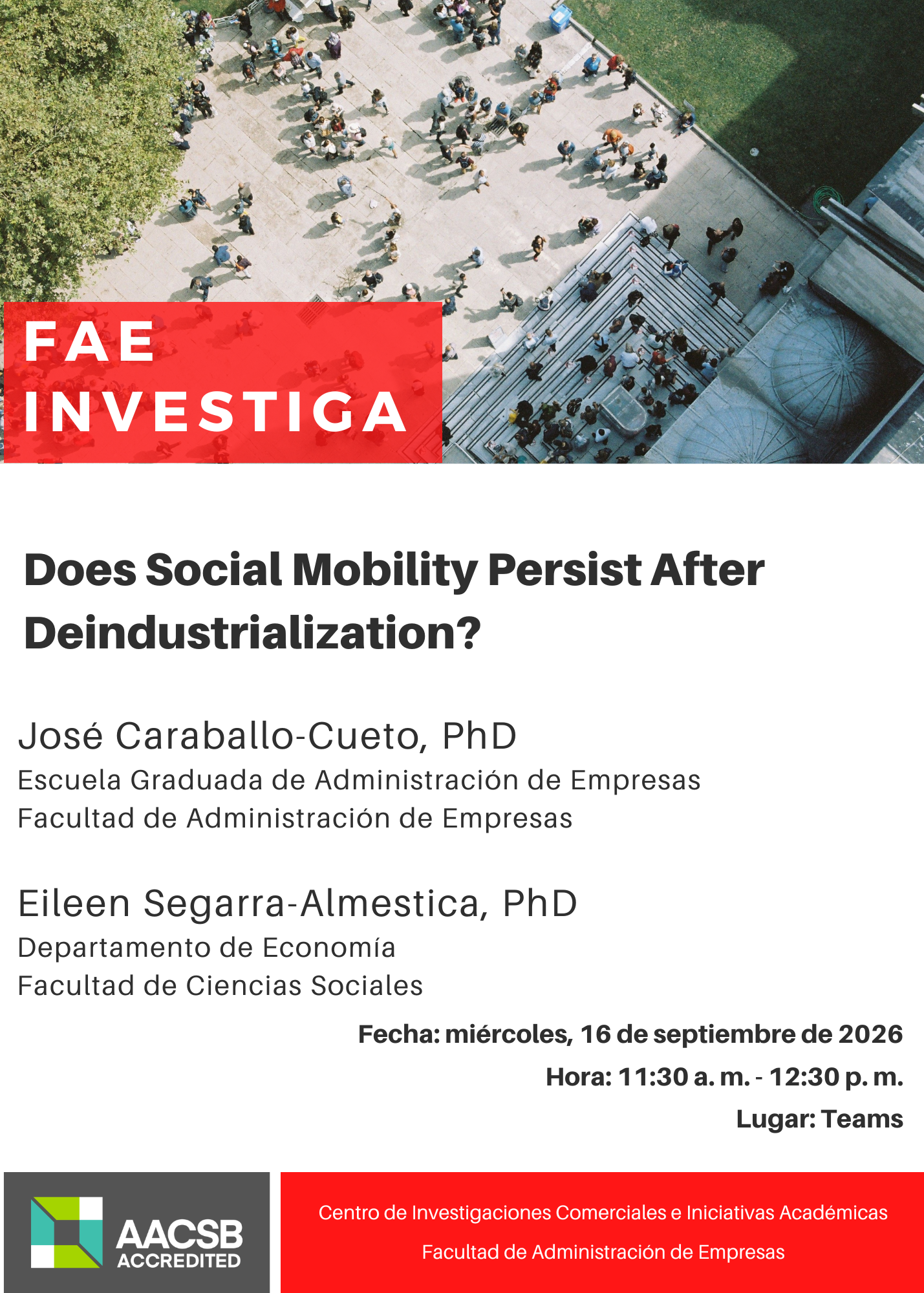
¡Saludos! Como parte de las actividades del centenario de la facultad, les invito a la primera presentación de este año académico de la serie FAE investiga. El doctor José Carabajllo Cueto, de la Escuela Graduada, compartirá con nosotros los resultados de su informe titulado “Does Social Mobility Persist After Deindustrialization?”
Fecha: miércoles, 16 de septiembre de 2026
Hora: 11:30 am – 12:30 pm
Lugar: Teams
Meeting ID: 212 385 092 979 342
Passcode: Bi6cm7sr
One would expect that industrialization, as a structural change, triggers social mobility. However, the effects of deindustrialization, a pervasive process that many economies suffer, on social mobility remain an understudied topic in current literature. We interviewed a random sample of 1,000 people aged 30 to 60 across Puerto Rico, an economy that was severely deindustrialized after a change in federal taxation. The database was then divided into two cohorts to consider the role of (de)industrialization on social mobility. It was found that most individuals experienced some degree of social mobility, whether measured through lifestyle or occupation status. Social mobility was lower for the post-industrialization generation but remained positive. Several factors explain social mobility, such as who the primary provider was when the person was 14 years old or the type of school they attended, but the main factor was educational attainment. That is, after controlling for personal and family characteristics, having achieved high levels of university education is the primary determinant of social mobility for both cohorts.
¡Espero verles!